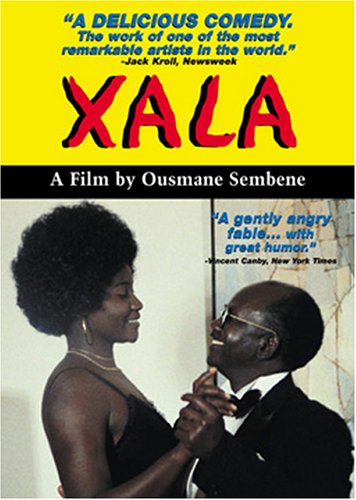
 First I would like to comment on the literal meaning of 'xala' in the book. When I first saw the title and began reading I thought xala was going to be something to do with government or a saying that meant change. When I read that xala was a course of male erectile disfunction I literally laughed out loud. It was a twist thrown into the story I did not see coming.
 Anyways aside from that humerous note I liked the fact that Ousmane depicted the different views of poligamy and the religion behind it. For example the daughter, Rama, did not agree with or understand poligamy and the belief's behind it. She constantly commented on the state of her mother's well being and how the marriages of El Hadji were affecting her. Secondly the awa, Adja Awa Astou was the first wife. She seemed to have a very religious air about her. She took a lot of pride and spent a lot of time studying, learning and living her religious views. She is a very patient person that deals with her husband's issues very well. I think she is quiet about her dislike for her husband's other wives, not so much she is green with jealousy and hatred, but sad and hurt that she is not the
only one. I think that would be the hardest thing to deal with in poligamy.
The next point of view is that of El Hadji. He was happy with his two wives in the beginning. He had the elder one whom was his first love and he respected and gave him a good reputation. He had his second wife which was younger and even more beautiful she also gave him kids, and like the first boosted his reputation. The idea of taking on a third wife was not his idea at all in the beginning. He lusted over he body yes, but he had no real need or want for another wife to spend money on. This brings me to another point of poligamy, El Hadji did not believe in some of the customs and traditions tha
t were associated with this religious tradition. During the wedding and before the women told him to obey the rituals but he refused because he thought they were silly. Him doing this kind of mocked himself and what he was doing. To put this in perspective for myself I thought of the christian religion. That would be like claiming to be a catholic but not wanting to participate in the sacraments, calling them foolish and silly.
The final character that I thought had an interesting perspective was N'Doye. She is depicted in the book as being around 20 years old, gorgeous and forced to like this successful man that had an erectile disfunction. She was to be the younger of the three wives, and she knew the jealousy that would be involved with the other two. She was going to be scorned by the othe

r two and had a lot to live up to. It seemed as if it was definetly an arranged marriage because she had no emotion in it. Her character is a little hollow, but she was still apart of this religious tradition.





 From the very beginning I didn't like this boy. The way the author described him made me want to skip over that chapter and continue on with Stanley. However further reading into the book proved that Leopold was a very imaginative character with many mysterious characteristics. His obsession with Africa had me wondering what he was really capable of if he had put his effort elsewhere; like ruling his country. His desire for these African colonies was ruining everything in his life. He had no relations with his wife, except the birth of his two daughters and no relationship with them either. He didn’t seem too concerned with the well being of his home country, everything was focused on his “Congo.” I thought it was interesting the way he fed off of Stanley’s emotions and skills to get him to explore for his small country. He had a peculiar way of playing with this famous explorer to get exactly what he wanted.