Thursday, November 6, 2008

Current Issue: HIV\AIDS


The current issue I decided to explore some more was the AIDS epedemic in Africa. This issue has been a problem for African countries but as of April 2008, it got worse for Nigeria.


"The Nigerian state of Anambra recently banned the promotion and distribution of what it calls "unnatural" contraceptives, including condoms. "Instead of teaching children how to use condoms and enjoy sex, they should be taught total abstinence," Amobi Ilika, the state commissioner for health, said when announcing the ban late last month. He added that the "use of condoms has greatly encouraged immorality."" (Kaisernetwork.com)

These issues have been plauging Africa for years, but it has only been recently that Western World News has recognized it as a problem. According to Globalissues.org, it wasn't until the 90's, around the same time the US declared AIDS as an issue that Africa had any attention called to its epidemic.

"What is also disturbing is how the situation in Sub-Saharan Africa only become real western mainstream media news headlines around the time HIV and AIDS was declared a national security threat to the United States. While it it understandable that a media may reflect concerns in its own nation, it is another example of the mainstream coverage and their priorities, especially when there is a lot to report in terms of western economic policies seen through the various international institutions that have increased poverty, an important factor in the spread of AIDS."
Finally after the belated western world media gave Africa some attention, multinational pharmaceutical companies began lobbying in developed countries. However this soon revealed that these companies were more worried about profit rather than Africans, because they would not allow African nations' to use generic versions of the namebrand drugs they had.
"Currently, treatments, which Medicines Sans Frontiers describe as having “transformed HIV/AIDS from a death sentence to a chronic disease in developed countries”, are expensive and affordable by mainly the wealthier people in western countries. However, poor people—including those in industrialized nations—are the major victims of HIV and AIDS."


In 2000 the Export-Import Bank of the US gave Africa one billion dollars to finance the purchase of U.S HIV\AIDS medications. However this heroic effort was also thrown unfairly because three countries: Namibia, South Africa and Zimbabwe were rejected the offer.


"With over 40 million people infected with HIV worldwide and over 11,000 new infections every day, universal access to comprehensive HIV prevention services is essential. In 2006, roughly 4.3 million people became newly infected with HIV, including roughly 530,000 children under the age of 15, most of whom were infected through mother-to-child transmission of the virus." (aidschannel.org)


To address this horrible epidemic the Global Aids Alliance has come up with a plan to help Africans deal with the HIV\AIDS issue in their country.

"The ABC approach
􀂾 Abstinence-until-marriage: refraining from sexual intercourse until marriage, or returning to
abstinence after a period of out-of-wedlock sexual activity
􀂾 Be faithful: committing to having sex with only one partner and avoiding casual sex; avoiding
“grazing”
􀂾 Condoms: using condoms correctly and consistently. “C” also represents comprehensive
prevention.
􀂾 The ABC approach is the HIV prevention model used by many organizations, including UNAIDS
and PEPFAR." ( globalaidsalliance.org )

Another aspect that was recently added to the ABC model was DEF.. which included a very important point in fighting AIDS.

"Education: Improving girls’ education
􀂾 In many countries, women and girls are the primary caregivers for their families. However,
when they are prevented from accessing resources or learning about nutrition and health,
entire families suffer. Additionally, lack of education is often a barrier for women who are
attempting to leave an abusive relationship.
􀂾 Eliminating school fees is a crucial first step to improving girls’ education. By eliminating these
fees, all families will be able to afford to send their children to school. Girls who receive an
education are more likely to be economically independent and understand the risks and
prevention methods of HIV. Further, when educated girls grow up and have families of their
own, they will be more likely to send their children to school, helping to break cycles of abuse
and poverty."


In my opinion this is huge. Later in the website it gave some more facts about AIDS prevention and education in Africa among young girls.


"Worldwide, young people ages 15 to 24 account for 40% of new HIV infections. And almost two-thirds of these newly infected young people are girls, who are especially vulnerable to HIV infection for a variety of social, cultural, economic, and physiological reasons. In addition, girls are often taken out of school to care for sick relatives or forced to go to work to replace family income lost due to AIDS deaths. Orphans are also at high risk of HIV and much more likely to be forced to leave school.
Millions of young people lack accurate information about HIV/AIDS, and girls tend to be more poorly informed than boys. But basic education can equip all children with the skills and knowledge they need in order to avoid HIV infection. Indeed, education links directly to safer behavior and reduced HIV infection rates, and experts agree that basic education ranks among the most effective-and cost-effective-means of HIV prevention. The Global Campaign for Education estimates that if all children received a complete primary education, as many as 700,000 cases of HIV could be prevented each year."

This is a great plan to stop the spread, but a number of obstacles are in the way, such as school fees, financial resources for schools, curriculum problems and The Fast Track Initiative.

AIDS\HIV has been a horrible issue in Africa for many years, but has only recently recieved attention for it. There is still a lot of work to be done, but luckily there are a lot of companies out there who are fighting for Africa.

Sunday, November 2, 2008

Waiting for an Angel


This amazing stories brought up a lot of questions and interesting topics about Nigeria and the horrible history it has. I really liked the writing and how the story of Nigeria was told so I did some research on Helon Habila to see what I could come up with.


Helon Habila was born in Nigeria in 1967. His father was a type of church worker who helped christian missionaries in Nigeria. He studied literature at the University of Jos and taught at the Federal Polytechnic Bauchi, before moving to Lagos to work as a journalist. In Lagos he wrote his first novel, Waiting for an Angel, which won the Caine Prize in 2001. In 2002 he moved to England to become the African Writing Fellow at the University of East Anglia. After his fellowship he enrolled for a PhD in Creative Writing. His writing has won many prizes including the Commonwealth Writers Prize, 2003. In 2005-2006 he was the first Chinua Achebe Fellow at Bard College in New York. His second novel, Measuring Time, was published in February, 2007. He currently teaches Creative Writing at George Mason University in Fairfax, Virginia, where he lives with his wife and two children.


He actually has a "Blogger" blog! You can find it here.

There were some themes to the book that I thought were very depressing and sad. For example the book starts in a prison cell with Lomba a seemingly innocent writer. It then moves to earlier history about a student who drops out of school, his closest friend loses his sanity in front of him, the terror the military brings, his novel never being finished and losing a woman to another man. This storyline spells out s-u-i-c-i-d-e! But not to worry there are undertones to this book that keeps the story moving and people from jumping out windows when they are finished reading it.


The characters in Waiting for an Angel are a representation of the story of Nigeria. They are individual stories of ordinary people living in extraordinary times. The whole time I was reading the story I kept thinking about Achebe and his story Things Fall Apart. The authors really capture the essence of the nation and the people during those times. I was reading articles about interviews Habila gave to people and it amazes me that this author still wants to write even with what goes on in Nigeria. He explained that in order to get a book or work published it has to be "Self-published." He stated that Nigeria does not spend the necessary money and time on scholarly literature or writers. Can you imagine not having an agent and getting your books out to the public single handedly? Its amazing what an inspiration these writers are and once you read their stories, the inspiration only soars higher.


My favorite character of the book had to be Aunt Rachael. In the beginning you see her as a compassionate aunt who takes her nephew in after his dad kicks him out. She feeds him and gives him a tutor for nothing. But later in the story we see her slipping, she begins drinking more heavily, and having more frequent outbursts. I don't blame her however, if someone left me like that I would be pretty depressed too. But! She is an amazing woman and bounces back. When Habila described her turning around I couldn't stop smiling. I thought of all the strong women in my life and all the women who have been through the same thing. Habila really captured the essence of womanhood and overcoming obstacles.


What can I say, I read this book in one sitting and LOVED it!

Wednesday, October 29, 2008

Black Gold


In the first article taken from National Geographic, I thought the title was a great opener. Curse of the Black Gold: Hope and betrayal of the Niger Delta. The hope part I sort of chuckled at because there was and is no hope for Nigeria. There are some very memorable and meaningful quotes throughout the essay I think are worth mentioning. The first comes from the first page when they are giving a brief introduction:

"The World Bank categorizes Nigeria as a "fragile state," beset by risk of armed conflict, epidemic disease and failed governance." From the World Bank website I found this new updates on their summary of Nigeria:
The World Bank is helping to fight poverty and improve living standards for the people of Nigeria. As of August 2007, the World Bank had approved 123 IBRD loans and IDA credits to Nigeria for a total amount of about US$9.5 billion. The commitment value of the 23 ongoing projects is about US$2.67 billion. The 23 active projects are in all the major sectors.

http://go.worldbank.org/KY8ZJIMB60 a look!

Little did they know how true this is to become. The essay states later that the attacks on the oil companies were becoming more frequent and more violent. Michale Watts was quoted saying:
"Across Africa you have a huge number of alienated youths, politically footloose, who thought they could achieve something with their countries' moves to independence and democracy. Those hopes have been almost everywhere violently snuffed out. The youth are pissed off and willing to up the ante."
After this comment various other people were talking about the situation in Nigeria and comparing it to the Middle East, they said "if the situation threatens to turn into another Middle East, then the world will finally intervene."

I don't completely agree with this statement. First because what is happening in Africa is worse in my standards than what happened in the Middle East. Their history and destruction they have endured is not comparable to that of the Middle East. Secondly the world has already intervened enough! They have taken control of Africa, without anything being wrong in the first place. The reason Nigeria and Africa as a whole are in such shambles is because of the world being there!
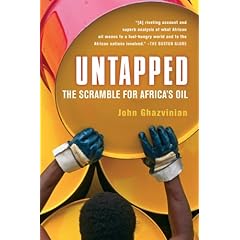
The second paper, Untapped: The Scramble for Africa's Oil, goes more into detail about why the big oil boom in Africa. One of the most interesting aspects I found in this essay was the blunt and horrid truth of it all. For example:
"This means that even if a civil war or violent insurrection breaks out on shore, the oil companies can continue to pump out oil with little likelihood of sabotage, banditry, or nationalist fervor getting in the way."
The oil companies know where they sit and what their power is in Nigeria and all over Africa. It is sickening to read about them knowingly deplete Africa of its resources. The paper also dictates that African oil is cheaper, safer, and more accessible than its competitors, and there seems to be more of it every day. This part of the essay compares Africa's oil to that of Saudi Arabia and other Middle East countries. The very first sentence puts this idea in concrete.
"United States now imports more of its oil from Africa than it does from Saudi Arabia."
I found this article while researching more about Nigerian Oil and I thought it put things in perspective very well :"Nigeria should be a massively rich country. It's the most populous country in Africa, and is the world's sixth leading oil producer. Over a quarter trillion dollars in oil has been lifted from Nigerian soils and waters in the last 40 years. But after years of military rule and rampant corruption, fueled by these oil monies, the country is mired in billions of dollars in debt and is wracked with poverty."

Monday, October 27, 2008

Chief Roles


As we read in our past few books, Europeans forced a lot upon the African civilization. One word that was mentioned and comes to mind quite often is corruption. According to Princeton University and Dictionary.com, Corruption is defined as the following:


1. lack of integrity or honesty (especially susceptibility to bribery); use of a position of trust for dishonest gain
2. decay of matter (as by rot or oxidation)
3. moral perversion; impairment of virtue and moral principles;
4. destroying someone's (or some group's) honesty or loyalty; undermining moral integrity;
5. inducement (as of a public official) by improper means (as bribery) to violate duty (as by commiting a felony)

Well this definition definetly hits the nail on the head. The Europeans were causing the decay of morals and loyalty of the Africans and using it all for dishonest gain. One group in particular that the European colonizers corrupted were the chiefs. As we discussed in class most of the "chiefs" were not chiefs but appointed by their clan members or Europeans to be the delegate. Then the colonizers put them in places of power which were not meant for them. They would either misuse this power or become in a sense slaves to the Europeans above them. On page 162 of Ancestor Stones it states:


"Somehow new of the strike had reached the chief who sent his messenger to alert the Distict Commissioner. Bu the time the strikers arrived the next morning DC Silk was waiting in front of the compound with his soldiers, ready to arrest the ringleaders."

This quote puts in perspective the power and uselessness of the chiefs placed in charge by European powers. They were the snotty teachers pet in the back of the room telling the teacher when kids were chewing gum.


I found this article that I think explains the hardships and exactly what Europeans did to the African culture very well.
Colonialism and Corruption in Sub-Saharan Africa:
"On the contrary, the practice of rewarding tax collectors became a principal
method for the accumulation of private property, a way of life that was hard to give
up which encouraged chiefs to abuse their office. As Leonard (1991: 29) put it,
colonial chiefs "were implicitly encouraged to use their positions to amass wealth
and demonstrate thereby that it paid to cooperate with Europeans".


"It was not the introduction of taxation per se, but the manner in which the tax
itself was collected, that encouraged corrupt behaviour. To collect taxes, the colonial governments mostly relied on local African leaders and especially chiefs.
Where chiefs did not exist or were unco-operative, new ones were appointed by the
colonial powers (Richards 1959; Crowder 1968). Above all, to motivate chiefs to
generate as much tax revenue as possible, and do so with zeal, the colonial
administrations allowed them to retain a part of it."

Jeffery Hanes (who I have been reading a lot of material from lately) wrote a review article about the power in Ghana from colonial times to the 1990's. His article is published in the journal, AFRICA.


"Although the two main colonial powers in the region, Britain and France, developed their own democratic systems during the 19th and 20th centuries, the political institutions they created in their African colonies were designed primarily as instruments of their domination and control. In most colonies, colonial administrative networks were grafted on to existing political institutions, and European hegemony and security were very closely linked. When they could be found, colonial administrations attempted to employ intermediaries, interlocutors- often known as "Chiefs"- to 'do their dirty work for them', that is, they were able to identify or, when neccessary, to create as authority figures the indigenous individuals who would be useful to the European goal of political and economic domination."


My point exactly.

Wednesday, October 22, 2008

Ancestor Stones Part 2

The last section of this book is titled appropriately, "Consequences." It was Serah's story in particular that laid this out.
"Sometimes I think this is what happened to our country. Nobody heeded the warnings, nobody smelled the rain coming, or saw the lights in the sky or heard the roar of thunder, until we were all engulfed by it."
Serah was invovled with the voting and political aspects of Sierra Leone. She watched as political leaders rose and fell and were replaced the next day with a new young President.
I found this timeline on BBC News:


1992 - President Joseph Momoh ousted in military coup led by Captain Valentine Strasser,

apparently frustrated by failure to deal with rebels. Under international pressure, Strasser announces plans for the first multi-party elections since 1967.

1996 - Ahmad Tejan Kabbah elected president in February, signs peace accord with Sankoh's rebels in November.
1997 - Peace deal unravels. President Kabbah deposed by army in May. Major Johnny Paul Koroma, in prison awaiting the outcome of a treason trial, leads the military junta - the Armed Forces Revolutionary Council (AFRC). Koroma suspends the constitution, bans demonstrations and abolishes political parties.
Kabbah flees to Guinea to mobilise international support.

1998 February - Nigerian-led West African intervention force Ecomog storms Freetown and drives rebels out.
1998 March - Kabbah makes a triumphant return to Freetown amid scenes of public rejoicing.
1999 January - Rebels backing Revolutionary United Front leader Foday Sankoh seize parts of Freetown from Ecomog. After weeks of bitter fighting they are driven out, leaving behind 5,000 dead and a devastated city.
1999 May - A ceasefire is greeted with cautious optimism in Freetown amid hopes that eight years of civil war may soon be over.
1999 July - Six weeks of talks in the Togolese capital, Lome, result in a peace agreement, under which the rebels receive posts in government and assurances they will not be prosecuted for war crimes.
1999 November/December - UN troops arrive to police the peace agreement

2000 May - Rebels close in on Freetown; 800 British paratroopers sent to Freetown to evacuate British citizens and to help secure the airport for UN peacekeepers; rebel leader Foday Sankoh captured.
2000 August - Eleven British soldiers taken hostage by a renegade militia group called the West Side Boys.
2001 January - Government postpones presidential and parliamentary elections - set for February and March - because of continuing insecurity.
2001 March - UN troops for the first time begin to deploy peacefully in rebel-held territory.
2001 May - Disarmament of rebels begins, and British-trained Sierra Leone army starts deploying in rebel-held areas.
2002 January - War declared over.
2002 May - Kabbah wins a landslide victory in elections. His Sierra Leone People's Party secures a majority in parliament.
2002 July - British troops leave Sierra Leone after their two-year mission to help end the civil war.
2004 February - Disarmament and rehabilitation of more than 70,000 civil war combatants officially completed.
2004 May - First local elections in more than three decades.
2005 December - The last UN peacekeeping troops leave Sierra Leone, marking the end of a five-year mission to restore order.
2006 August - Date for elections set for July 2007.
2007 August - Presidential and parliamentary polls. Ernest Bai Koroma wins the presidency and his All People's Congress, formerly in opposition, wins a majority in parliament.


*The picture has a link too! Its the Absence of Violence in Sierra Leone from 1996-2007


I cut some of the dates out because it was just too long. But this timeline was eyepopping! I mean that much destruction and turmoil lasting for over 10 years! Also the end of the timeline doesn't even stop at 2007, which means the country is still in a mess. I did some more research on Sierra Leone and this is what I found:


Reflections on the 1996 Sierra Leone Peace Accord
by Yusuf Bangura

"The signing of the peace accord in Abidjan (Côte d’Ivoire) on 30 November 1996 between the government of Sierra Leone and the Revolutionary United Front (RUF) marked the official ending of Sierra Leone’s five and a half years of war. The war, which ravaged much of the countryside, killed more than 20,000 civilians and left hundreds of innocent bystanders maimed and traumatized. It also displaced almost one and a half million people from their homes and livelihoods, orphaned thousands of young children, and imposed financial and social burdens on much of the relatively stable population. One major consequence of the war, which post-war reconstruction efforts will have to tackle very quickly and decisively, was the transformation of the country from a predominantly rural society into pockets of dense urban settlements. Medium-sized provincial towns such as Bo, Kenema, Makeni and Koidu suddenly became large urban settlements as villagers sought refuge in them. And the capital, Freetown, could well have grown from a pre-war population of roughly half a million people to one million—if not more."

This paper details the events leading up to the Peace Accord as well as what followed after. Ancestor Stones detailed a little of the turmoil happening in Seirra Leone with Serah's story, but after this new information I learned, I am surprised this character even left her house admist this horrible war. I didn't fathom the consequences she would have to deal with if things got out of hand. Her and her friend, plus any of the citizens that showed up that day to vote could have been killed point blank. And that is exactly what happened to most of the people during those times.

Monday, October 20, 2008

Ancestor Stones Women


It still amazes me the lack of respect for women from others and the lack of respect women have for themselves. While finishing the last sections of the book Ancestor Stones the letters written by these women made me angry and repulsed. These women who I held in high reguard until these chapters were giving themselves to men who had no respect or even a care for them. They were selling themselves short, settling for the first man who came along and litterally swept them off their feet and shoved them into their homes like servants. Not once did they complain or protest or even cry they just did as they were told and became women servants to a man. It disgusted me that they would just lay night after night waiting for their pig of a husband to come and get them preganant so they could be left alone to bear children. One quote in particular that put the woman's situation in perspective was from Hawa,
"I can't say I either liked him or disliked him. I was prepared to live with him. To accept my fate for what it was. But always he wanted something more. My fate was no longer in my own hands (180)."


Later she dug the nail in deeper by stating this sad passage,


"And though I didn't encourage my husband I fufilled my duties. I bore him three children. All boys. I lost two more. They were girls and might have grown up to help me around the house. But there it is. Nothing to be done. What more could any man ask for? Each time my belly swelled, he would kneel, press his cheek against it and close his eyes (180)."


Another part of Hawa's story that made me cringe was when she went back to the city to find the doctor who tied her tubes. Not only did it show her desperation for a man, but it also showed how little respect men had for women. This doctor had tied her tubes without even telling her! They just went in and snip snip.

"Still I persisted. You see, I had come to that city for a reason. I had to find the doctor, the one who had tied my tubes. To ask him if he might undo what he had done, so that I could bear children again. It was the only thing I could think of to stop Zainab from replacing me (198)."

Although I particularly enjoyed the story Asana told about her threatening her husband while he slept.
""Osman" I said. "Wake up and see. See what I have for you!" I groped the floor until my fingers closed around the handle of the knife. I held it up, allowing the blade to glow in the silver light. I put my lips very close to his ear, brushing the lobe. I made my voice gentle, coaxing. Osman's eyes opened. I put the blade up under his chin: the tip made a soft indentation in the flesh, "You see what can happen, Osman? So strong but what good do your muscles do you now?" I felt his body slowly stiffen (118)."
She woke him from his sleep just enough to where he was listening but not registering and threatened his life!. I laughed so hard at this part she became my favorite character. Finally a woman was standing up for herself. She could have been more direct about it, but this worked too. And after this small threat her husband did in fact leave her alone for the most part.


"From that night and for the remainder of my pregenancy Osman never touched me again. I congratulated myself heartily on my cunning. I lay back on my bed...(120)."

It enraged me the lack of respect for these women. Yes, it is their culture, but the women do not even have resepct for themselves, so asking for some from others isn't worth it.


Sunday, October 19, 2008

Ancestor Stones Part 1


The first 5 chapters of Ancestor Stones were very different from any of the other books we have read in class so far. They reminded me of the "Diary of...." books I used to read when I was younger. These books were set up as diary entries of young girls in the middle of important historical events, such as the trip across the ocean when Columbus made his discovery of America.


They were depicted in the first person just as these stories, except it was about them rather than their mothers and how the affected their lives. Before we discussed the family tree in the front of the book I had no idea how these girls were related. I figured they were all Africans writing about their experiences with their mother. On Tuesday when Dr.Webb showed us the family tree in the front of the book, everything sort of clicked and it helped me as I read the next few sections.


My favorite story would have to be Asana. She was the older twin born before her brother but had her birth right of being first born taken from her. She wasn't furious about the title being taken away but she definitely felt rejected because of it. When she was describing his or her upbringing I couldn't help but laugh because she was obviously maturing long before her brother but no one seemed to notice. She was walking before he could even crawl properly, which in my eyes shows us that she was the oldest. I wondered why the women and men around her mother didn't question who was the oldest. Nonetheless Asana took on the responsibility of being the older sibling and taking care of her brother. I could relate so well to this portion because I too am an older sister.


Yes taking care of younger sisters can be tedious and take away from your own childhood, but in the end it forms you into a more caring and responsible person. She said she was jealous at times of her brother, but when he died she didn't show any form of happiness that he was gone or distain towards him. I admired her instantly for this and she became my favorite character so far.
The next story that I wanted to cry about was that of Mariama. I don't have my book with me right now, but her story is more about her mother rather than that of her and her siblings. The way she describes her adoration and love for her mother is amazing. Her way of explanation isn't trying to portray love and affection she is just telling the reader how it is, which makes it all the more memorable.
Like all the other characters before her she stated how her mother was the most loved and cherished by her father. I'm not sure if this was so because she concentrated more on her and her mother's relationship rather than between her mother and father. When she describes their private time together this girl has nothing but love and adoration in her heart for her mom. When she looses her mother in the end that just about killed me. I could imagine her being torn away from that special relationship with her mother and made into a young woman without any questions being asked.
*The pictures are of my sisters and I and my mom and sister.