Saturday, September 13, 2008

Malaria


When I signed up for this topic in class I thought that it would have the most information. Unfortunately when I type in anything about European Colonization and Malaria, the most relevant information I get is that Historians speculate that Europeans brought malaria to Africa, and many Africans died as a result. This also held true for when Europeans came to America and brought with them diseases that the Native American's died from. This disease came to Africa many centuries earlier but still seems to be an epidemic in Africa.


Malaria is a vector-borne infectious disease caused by protozoan parasites. According to Wikipedia malaria is spread through mosquito bites which transfer the parasites from one host to another. These parasites then multiple on red blood cells very quickly. Upon further investigation I found the symptoms of malaria which sound aweful. Malaria attacks usually last 4 to 6 hours with shaking chills, fever and sweating. They are normally associated with fatigue, headaches, dizziness, nausea, abdominal pain, cough, muscle and joint pain and back aches. The attacks usually occur every other day or every third day. There are preventative medications available for this horrible disease, but for most people living in Africa and other affected areas they are too expensive.


Malaria still reeks havoc on African civilization an estimated 300 to 500 million cases emerge each year. It causes 1.5 to 2.7 million deaths per year, with over 90% being children under 5 years old. These cases in Africa account for more than 90% of the malaria cases in the world.


One very interesting fact I found about malaria is where this disease is prevolent, the disorder, Sickle Cell Anemia is not present. According to Wikipedia, one or two alleles of the sickle-cell disease are resistant to malaria since the sickle red blood cells are not conductive to the parasite - in areas where malaria is common.

Wednesday, September 10, 2008

My First Visit


Upon my first visit to Umuofia I was placed next to the Christian Misson as an OSU (untouchable) or one who was diseased in the book, Things Fall Apart. When I looked further into the place I came across this picture (<--), with the description being that this is a masked man protesting the Christian Misson. At first glance he looks unintimidatin and almost friendly but after I looked at the mask for a while I started to notice the patterns. Doing further research into the patterns on the mask I found that most african masks have similar patterns on them. According to African Masks, most patterns on masks are symmetrical and are used as coded information. zigzag, cruciform, and spiral lines denote social status or have some belief to hold religious or magical powers.

Anoter website detailed that African masks are danced to make a connection between the human and spirit worlds, usually to reinforce social controls and relgious beliefs. There are many types of masks ranging from depiction of woman, royalty and animals. I can't figure out how to load video but I found a Youtube broadcast that was pretty cool, featuring African dancers with their masks. So here's the link : http://www.youtube.com/watch?v=eckCUEo0jHw&feature=related

Reading the different meanings and social issues behind masks had me relating these to that of English masquerades. In this celebration people put masks on to hide their true identity and be a "different person" for the night. Some masks have special meanings and give away certain physical attributes, but none are as intricate as African masks. Africans use their masks for almost every celebration, ceremony and community hearing they have.

This particular mask in the picture reminded me of one that an elder would be wearing at the clan hearings. There are only small slits to see through and other than their body, you cannot tell any facial features on the person. The patterns are sort of familiar to that of a cat's whiskers and a goat's horns, so it could be an animal mask as well as a gods.


Monday, September 8, 2008

Things Fall Apart

I just finished the book, Things Fall Apart and surprisingly I enjoyed the book. Some of the language used was difficult to understand at first, but eventually I got the hang of it.

I did some research on the language of the Ibo tribe and found that it is very different from other languages around the world. According to The Africa Guide, the Ibo language is based on voice pitches, vocal inflections and context when defining a word. One word in the Ibo language can have multiple meanings. In the book the people also rely heavily on proverbs and stories to convey their message. The Africa Guide also mentions this important role in the Ibo language.


Some of the Ibo terms used are listed in the back of the book, but I thought it was more fun to sound them out outloud and interpret their meaning as I saw fit. The character names were also a lot of fun to pernounce and say outloud. Further investigation into the reading layed out the sounds of instruments and nature as words and symbols in the Ibo language. For example when the chiming of the gong is done, it is spelled out in the book as if the sounds are words to the Ibo people to be interpreted. The Ibo language is one of the four official languages spoken throughout Nigeria. According to Omniglot ,G. C. A. Oldendorp, a German missionary, was the first person to produce a book containing material written in Igbo, which consisted of a few words and phrases. His book, Geschichte der Mission der Evangelischen Bruder auf den Carabischen (History of the Evangelistic Mission of the Brothers in the Caribbean), was published in 1777.
Here is a sample of the Ibo language which is a translation of Article 1 of the Universal Declaration of Human Rights:
A mụrụ mmadụ nile n'ohere nakwa nha anya ugwu na ikike. E nyere ha uche na mmụọ ime ihe ziri ezi nke na ha kwesiri ịkpaso ibe ha agwa n'obi nwanne na nwanne.


The names of the characters in the book and the names of the Ibo people also held various meanings. Their names reminded me of Native American names like "One who Dances" and such because their names meant the same thing. On page 162 Okonkwo names his son Nwofia which means "Begotten in the Wilderness."


Religion and Tradition influence the Ibo's way of life very heavily.
Throughout the entire story Okonkwo relays Ibo lifestyles according to customs, religion and lifestyles layed out by ancestors and gods before them. The Ibo people have many gods that they worship for various reasons, much like the Greek and their gods. There is a god of the land, water and even war. But later on in the story when the Christians arrive the reader learns about a supreme god named, Chukwu. The Christians interpretted this as the Ibo believing in their "God" and this Chukwu was him. But my understanding of the reading was that the Chukwu was a Zeus type being, just a god that was higher than the rest. The religious traditions were emphasized throughout the story which proved how strong their belief system was. Okonkwo believed so much in his gods that he exiled himself from his home, his people and his countrymen because of the law of the gods.
Reading more about Ibo religion and traditions I found that after the British colonization the Ibo people were thrown into turmoil and confusion. The widespread force of Christianity ruined the Ibo traditions and caused much grief and ruin among the Ibo.


Wednesday, September 3, 2008

African History Before Colonization


Africa before colonization was very different than the Africa after the Europeans came into the picture. According to Amanda Brooks, Africans had a hard time seperating their religious lives from their every day lives. For example instead of moving forward with agricultural processes they relied on praying and the spirits they prayed to. They were very devoted to their religious practices but it often hurt their agricultural production than helped it. The Africans used this ideology for all of their economic, political, hunting and harvesting aspects of their lives. Their lack of agricultural advancement wasn't all bad however; the African people were communal which means they shared and distributed goods based on kinship. This meant that the African people relied on eachother for survival and although it was not seen as advancement by Europeans, it worked for the African people.


Another aspect that was considered very different and frowned upon by the early Europeans was the lack of technology. Africans had invented their own technology based on the enviornment such as; terracing, crop rotation, swamp farming and mixed farming. They also created their own tools such as hammers and hoes, but their lack of scientific methods and knowledge left them with tools in desperate need of upgrades. The African social stratification was also thrown for a loop when the European settlers came about. The original chain of command begane with the headship elders or sucessful families with the most livestock. But there was not much more in the way of social classes in Africa.

Before European colonization borders between countries

was not an issue with native Africans. But soon after the

European take over borders were set up all over the country dividing it into seperate nations rather than a country in whole. These borders also set up ethnic divisions among the people where they did not exist before. This introduced a cultural dichotomy which proved to be detrimental to African civilization.


Tuesday, September 2, 2008

Just A Little About Me

Well beginning with the basics, my name is Kathleen, but my friends call me Kat. I like to consider myself an adventurous and spontaneous person, but my shyness often gets in the way. I am technically a junior here at Western but because I am a transfer student I'm still working on the credits. I am originally from Harbor Beach Michigan, which is a tiny town in the thumb of Michigan. I graduated from Harbor Beach High School in 2006 and originally started my college career at Saginaw Valley State University. But since then I have changed my major from Social Work to Secondary Education English major, but I am still undecided on my minor.
My goal is to teach middle school, preferably 8th grade but high school would be fine too. I am also aiming at teaching on an Indian reservation, perhaps the Navajo Reservation in Arizona.
I have my EMT (Emergency Medical Technician) certification but currently I am not working for an ambulance company. However I am working at the Boys and Girls Club of Kalamazoo, which takes up a lot of my free time. I also work for the WMU's Athletic Department, which means I set up for the home varsity sport games.
I chose to take this class primarily it is among the required courses for English majors, but I am doing a missions trip this summer to Africa so a little background and extra information never hurts. I live on campus in Valley 3, even though I am a Junior, but it isn't as bad as it seems. My suite mates this semester are freshmen so it ought to be an interesting time.
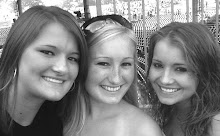
( I'm the blonde one in the picture!)